

As men, we seem to have a cultural obsession with “the grind.”
We are taught that success belongs to those who wake up before the sun, crush a high-intensity workout, work a 12-hour day, and sacrifice rest in the name of ambition. We wear our sleep deprivation like a badge of honor, bragging about how we can function on four hours of sleep and three cups of black coffee.
But while you are grinding, your biology is crumbling.
If you are a man looking to optimize your testosterone naturally—whether to build more muscle, shed stubborn belly fat, or reclaim the libido and drive you had in your early twenties—you likely have your diet and training dialed in. You’re tracking macros. You’re lifting heavy. You might even be taking a stack of expensive supplements.
But if you are neglecting your sleep, you are stepping over 100-dollar bills to pick up pennies.
The truth is that sleep is not merely “downtime.” It is not a passive state where your body shuts off. Sleep is an active, metabolic state of intense hormonal construction. It is the most potent, natural performance-enhancing drug available to you, and it is completely free.
If you want to maximize your masculinity and your hormones, it is time to stop viewing sleep as a weakness and start viewing it as your primary anabolic window. Here is the science of why rest is your secret weapon, and the exact protocol to fix it.
The Science: How Sleep Fuels the Male Engine
To understand why sleep is non-negotiable for high testosterone, we first have to understand how the male endocrine system operates.
Your body is like a factory. During the day, that factory is in “production mode”—you are expending energy, tearing down muscle fibers in the gym, and using mental focus to solve problems. But the factory cannot repair itself while the machinery is running.
Repairs—and specifically, the production of vital hormones—happen during the night shift.
The “Recharge” Window: REM and Deep Sleep
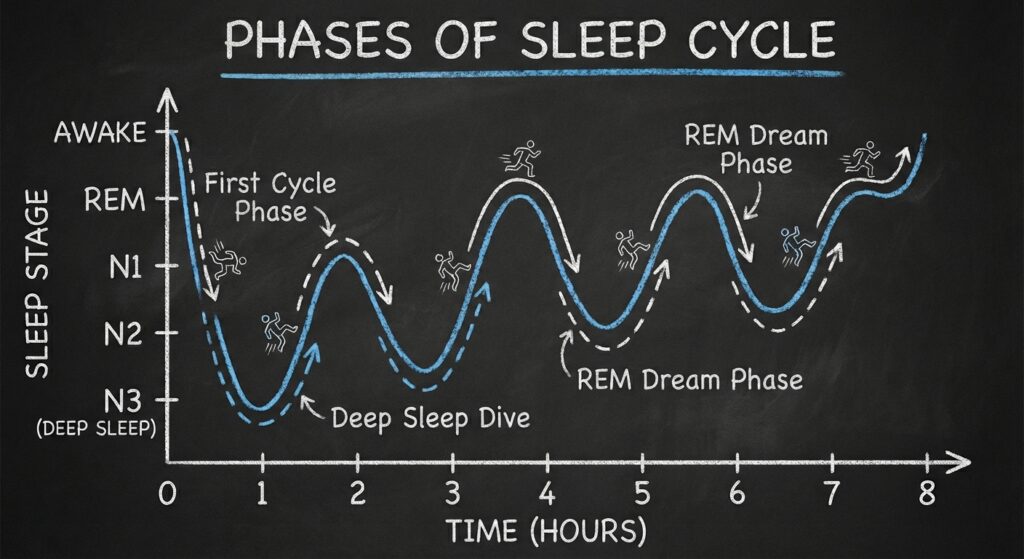
Testosterone production is not a steady drip that happens 24 hours a day. The vast majority of your daily testosterone is released in pulses while you are asleep. This process relies heavily on your sleep architecture, specifically Rapid Eye Movement (REM) sleep and Deep (Slow-Wave) sleep.
- Deep Sleep: This is the physically restorative stage. During deep sleep, the pituitary gland pulses out Growth Hormone (GH) and Luteinizing Hormone (LH). LH is the signal that travels down to the testes and commands them to produce testosterone.
- REM Sleep: This is the mentally restorative stage. While primarily associated with memory and mood, research suggests that fragmented REM sleep disrupts the hormonal signaling required for peak testosterone production.
If you cut your sleep short, you aren’t just “tired.” You are physically cutting off the supply chain of hormones before your body has finished manufacturing them.
The University of Chicago Study
If you doubt the severity of this connection, look no further than the landmark study conducted by the University of Chicago. Researchers took a group of healthy young men and restricted their sleep to five hours per night for just one week.
The results were catastrophic.
After just seven days of restricted sleep, the men’s testosterone levels dropped by 10% to 15%. To put that in perspective, testosterone naturally declines by about 1% to 2% per year after age 30. This means that one week of bad sleep effectively “aged” these men by more than a decade.
If you are sleeping five hours a night, your endocrine system is functioning like that of a man 10 to 15 years your senior. You are literally aging yourself overnight.
The Circadian Rhythm Peak
Your body runs on a master clock known as the Circadian Rhythm. In a healthy male with a synchronized clock, testosterone levels naturally rise throughout the night and hit their absolute peak in the early morning, usually around 8:00 AM.
This is why you (ideally) wake up feeling charged and ready to attack the day. However, if your sleep schedule is erratic—if you go to bed at 1:00 AM one night and 10:00 PM the next—or if you simply don’t sleep enough, you blunt this morning peak. You start your day with a half-empty tank, forcing your body to rely on adrenaline and cortisol to get moving.
The Enemy: Cortisol vs. Testosterone
You cannot talk about testosterone without talking about its arch-nemesis: Cortisol.
In the human body, these two hormones have an antagonistic relationship. Think of them as two kids on a see-saw. When one goes up, the other must come down. They rarely occupy the high ground at the same time.
The Stress Signal
Cortisol is your primary stress hormone. It is designed to help you survive immediate threats (the classic “fight or flight” response). When cortisol is high, the body shifts into a state of emergency.
From an evolutionary standpoint, sleep deprivation is interpreted by the body as a state of danger. If our ancestors weren’t sleeping, it was usually because they were being hunted, they were starving, or they were migrating through harsh conditions.
When you stay up until 2:00 AM doom-scrolling or answering emails, your body doesn’t know you are safe in bed. It perceives the lack of rest as a survival threat. It floods your system with cortisol to keep you alert.
The Catabolic State
Here is where it destroys your gains. Cortisol is catabolic, meaning it breaks down tissue for energy. Testosterone is anabolic, meaning it builds tissue.
When you are sleep-deprived and cortisol spikes:
- Your body inhibits the Hypothalamic-Pituitary-Gonadal (HPG) axis, effectively shutting down the signal to produce testosterone.
- Your body enters a muscle-wasting state to liberate amino acids for quick energy.
- Your body hangs onto visceral fat (belly fat) as a survival mechanism.
This creates a vicious feedback loop. High cortisol leads to increased belly fat. Belly fat contains an enzyme called aromatase, which converts your existing testosterone into estrogen. Higher estrogen and lower testosterone lead to poorer sleep quality… and the cycle continues.
By prioritizing sleep, you are essentially engaging in cortisol management. You are lowering the stress hormone so that the anabolic hormone (Testosterone) has the space to rise.
Signs Your Sleep is Killing Your Gains
How do you know if your sleep is the bottleneck in your testosterone optimization? You don’t need a blood test to see the early warning signs; you just need to listen to your body.
Here are four major signs that your sleep habits are chemically castrating you.
1. The Disappearance of Morning Wood
Nocturnal Penile Tumescence (NPT), or “morning wood,” is the canary in the coal mine for male health. Healthy men should experience 3 to 5 erections per night during REM cycles, waking up with the final one.
This isn’t just about libido; it is a physical manifestation of your overnight testosterone pulse and vascular health. If you rarely wake up with an erection, it is a glaring sign that your REM sleep is fragmented or your testosterone production is suppressed.
2. The Afternoon Crash
Do you hit a wall at 2:00 PM? Do you feel like you need a nap, a sugar hit, or a double espresso just to function in the second half of the day?
While a slight dip in energy is natural post-lunch, a complete crash indicates that your circadian rhythm is out of alignment. You are running on cortisol fumes from the morning, and once those wear off, your system collapses.
3. Gym Stagnation and “Skinny Fat”
You’re lifting heavy four days a week. You’re eating protein. Yet, your bench press hasn’t gone up in months, and you can’t seem to shake that layer of fat around your lower abs.
This is the classic “high cortisol, low sleep” physique. Without deep sleep, you are not releasing enough Growth Hormone to repair the micro-tears in your muscles. You are doing the damage in the gym, but you aren’t allowing the construction crew (sleep) to come in and build the muscle. You are essentially training for nothing.
4. Brain Fog and Lack of Drive
Testosterone is a neurological hormone. It drives dopamine—the molecule of motivation. When your T-levels tank due to poor sleep, your competitive edge evaporates. You find yourself procrastinating, feeling indifferent about your goals, or suffering from “brain fog” where you can’t focus on deep work.
The “High-T Sleep Protocol”
Knowing the science is useless without action. You need a strategy.
Do not think of this as “sleep hygiene.” Hygiene is boring; it’s something you do because you have to. Think of this as a Recovery Protocol—the same way you have a lifting protocol or a nutrition protocol.
Here is the step-by-step plan to maximize anabolic hormone production overnight.
1. Light Control: The Master Switch
Light is the primary signal that sets your circadian rhythm.
- Morning Protocol: Within 30 to 60 minutes of waking up, you must get natural sunlight into your eyes. This signals the pituitary gland to release a healthy spike of cortisol (to wake you up) and sets a timer for melatonin release 12–14 hours later.
- Evening Protocol: Artificial blue light (from phones, laptops, and TVs) suppresses melatonin, the hormone that signals sleep. If you blast your eyes with blue light at 11:00 PM, your brain thinks it is noon.
- Action: Install blue-light blocking software (like f.lux) on computers. Use “Night Shift” on your phone. Ideally, put on blue-light blocking glasses 90 minutes before bed and dim the overhead lights.
2. Thermal Regulation: Freeze the Room
Your body cannot enter deep, restorative sleep until its core temperature drops by about 2 to 3 degrees Fahrenheit. If your room is too hot, your body struggles to dump heat, preventing you from entering the deepest phases of sleep where GH is released.
- Action: Set your thermostat between 65°F and 68°F (18°C – 20°C). It should feel chilly when you aren’t under the covers. If you can’t control the AC, use a fan or invest in a cooling mattress pad.
3. Nutrient Timing: The 3-Hour Rule
Digestion is an energy-intensive process. If you eat a heavy meal right before bed, blood flow is diverted to your stomach rather than your brain and muscles for repair. Furthermore, an insulin spike before bed can inhibit Growth Hormone release.
- Action: Stop eating 3 hours before bed. If you go to sleep at 11:00 PM, the kitchen closes at 8:00 PM. This allows your blood sugar to stabilize and your heart rate to drop, leading to higher Heart Rate Variability (HRV) and better recovery.
- Caffeine: Caffeine has a half-life of about 6 hours. If you drink a coffee at 4:00 PM, half of that caffeine is still in your system at 10:00 PM. Cut all caffeine by 2:00 PM.
4. Oxygenation: Mouth Taping
This sounds strange, but it is a game-changer. Many men suffer from mild sleep apnea or snoring, often caused by mouth breathing. When you breathe through your mouth at night, you alter the balance of oxygen and carbon dioxide in your blood, and you often wake up continuously (micro-wakes) without realizing it.
- Action: Train yourself to breathe through your nose. Nasal breathing increases nitric oxide production (great for blood pressure and erections) and ensures deeper sleep. Use a small piece of porous medical tape to keep your lips sealed at night.
Natural Sleep Aids for Testosterone
Supplements are not a replacement for the protocol above. However, if your routine is dialed in, these compounds can help you relax and stay asleep.
- Magnesium Glycinate (400mg): Most men are deficient in magnesium. It is essential for over 300 enzymatic processes in the body, including CNS (Central Nervous System) downregulation. Taking Glycinate or Bisglycinate before bed helps relax muscles and lower anxiety. Avoid Magnesium Citrate, as it acts as a laxative.
- Zinc (30mg): Zinc is vital for testosterone production and preventing the aromatization of testosterone into estrogen. Studies show zinc supplementation improves sleep quality in those with a deficiency.
- Ashwagandha (KSM-66): An adaptogen that lowers cortisol. By crushing stress levels, it indirectly helps you sleep and preserves testosterone. Note: Cycle this. Take it for a few weeks during high-stress periods, then cycle off.
- Glycine (3-5g): An amino acid that helps lower core body temperature, helping you get into deep sleep faster.
FAQ: Addressing Common Objections
“I’m fine on 5 hours of sleep. I’ve done it for years.”
You think you are fine, but you have likely just adapted to a lower baseline of performance. This is called “sleep drunkenness.” Subjective feelings of sleepiness plateau after a few days of restriction, but cognitive performance and hormonal markers continue to plummet. Unless you have the rare genetic mutation (DEC2 gene) present in less than 1% of the population, you are not “fine.” You are functioning at 70% capacity.
“I can’t sleep because my job is too stressful.”
This is a “Catch-22.” You are stressed, so you don’t sleep. But because you don’t sleep, your cortisol rises, making you more stressed. You must break the cycle physically. Utilizing the “High-T Sleep Protocol”—specifically the magnesium and the cooling of the room—can force a physiological shift that calms the mind, even when work is crazy.
“Can I just catch up on sleep on the weekends?”
You can pay back some “sleep debt,” but you cannot fully reverse the hormonal damage of a week of deprivation in two days. The metabolic disruption and insulin sensitivity issues caused by Monday-Friday sleep restriction tend to linger. Consistency beats binge-sleeping.
Final Words
In the quest for high testosterone, it is easy to get distracted by the shiny objects: the expensive protein powders, the aggressive lifting splits, and the exotic herbs.
But the foundation of the male pyramid is sleep.
You can eat the perfect diet and train like a beast, but if you are sleeping five hours a night, you are driving a Ferrari with the parking brake on. You are working against your own biology.
Here is your challenge: Commit to the “High-T Sleep Protocol” for just 7 days.
- In bed 8 hours before your alarm goes off.
- Room at 65-68 degrees.
- No food 3 hours before bed.
- No screens 1 hour before bed.
Track your morning energy and your libido. You will likely find that the best “testosterone booster” in the world isn’t a pill—it’s your pillow.
Stop grinding yourself into the ground. Go to sleep.
References
Leproult, R., & Van Cauter, E. (2011). Effect of 1 Week of Sleep Restriction on Testosterone Levels in Young Healthy Men. JAMA, 305(21), 2173–2174. doi:10.1001/jama.2011.710
Leave a Reply